Understanding Variola: From Blisters to Global Eradication
Smallpox, a name that once struck fear into the hearts of millions, represents one of humanity's greatest struggles against infectious disease. Caused by the highly contagious
Variola virus, this ancient affliction left a devastating trail of suffering, disfigurement, and death across continents for millennia. Its characteristic fluid-filled blisters were a harrowing sign of an illness that claimed countless lives. Yet, its story culminates not in perpetual dread, but in an unparalleled triumph of global public health: its complete eradication. This article delves into the nature of
Variola: The Only Human Disease Eradicated Globally, from its insidious beginnings to its historic defeat.
The Variola Virus: A Historical Scourge
At the heart of smallpox was the
Variola virus, a complex pathogen belonging to the genus *Orthopoxvirus*. The very name "Variola" is derived from the Latin word "varus," meaning "knot" or "pimple," a stark descriptor of the disease's most visible and infamous symptom: the characteristic skin lesions. For centuries, before scientific understanding could unravel its mysteries, smallpox was simply known as "Pocken" in German, or "Blattern" and "small pocks" in English, often distinguished from "great pocks" (syphilis) due to their similar, though distinct, skin manifestations.
The Variola virus was a master of transmission, primarily spreading through the air via respiratory droplets from an infected individual, making it incredibly difficult to contain. Its incubation period, typically ranging from 10 to 14 days, meant that an infected person could unknowingly spread the virus before symptoms even manifested. This silent spread contributed significantly to its widespread outbreaks and its devastating global impact, wiping out entire populations and altering the course of human history. Unlike many other diseases, Variola had no known animal reservoir; it was an exclusively human pathogen, a fact that would later prove crucial in its eventual eradication.
The Unmistakable Progression: From Early Signs to Characteristic Blisters
The journey through smallpox was a predictable, yet horrifying, progression, moving through distinct stages that left an indelible mark on its victims.
The Prodromal Phase: The Storm Before the Eruption
The onset of smallpox was typically sudden and severe. Following the incubation period, individuals would experience a prodromal phase characterized by:
- Sudden Chills and High Fever: Often spiking dramatically, indicating the body's battle against the rapidly multiplying virus.
- Intense Back Pain: A distinctive and often debilitating symptom, reported as "starke Kreuzschmerzen," or severe lumbosacral pain, setting smallpox apart from many other febrile illnesses.
- Headaches and Anorexia: Accompanied by a general feeling of malaise and profound weakness, making patients feel extremely ill ("Allgemeines befinden sehr schlecht").
- Initial Rash (Transient): In some cases, a fleeting, non-specific rash, known as an initial exanthem, might appear on the inner thighs or abdomen. This rash usually faded before the true smallpox eruption began, often causing diagnostic confusion if misidentified.
The Eruptive Phase: The Blisters Take Hold
The true signature of smallpox emerged around the third or fourth day, often coinciding with a deceptive drop in fever, leading to a brief period of false hope. This was the start of the eruptive phase, a meticulously synchronized progression of skin lesions:
- Macules (Roseola): Small, flat, red spots (roseola) would first appear on the skin. Unlike chickenpox, the smallpox rash often started on the face and extremities before spreading to the trunk, following a centrifugal distribution.
- Papules: Within two days, these macules would transform into raised, solid bumps known as papules.
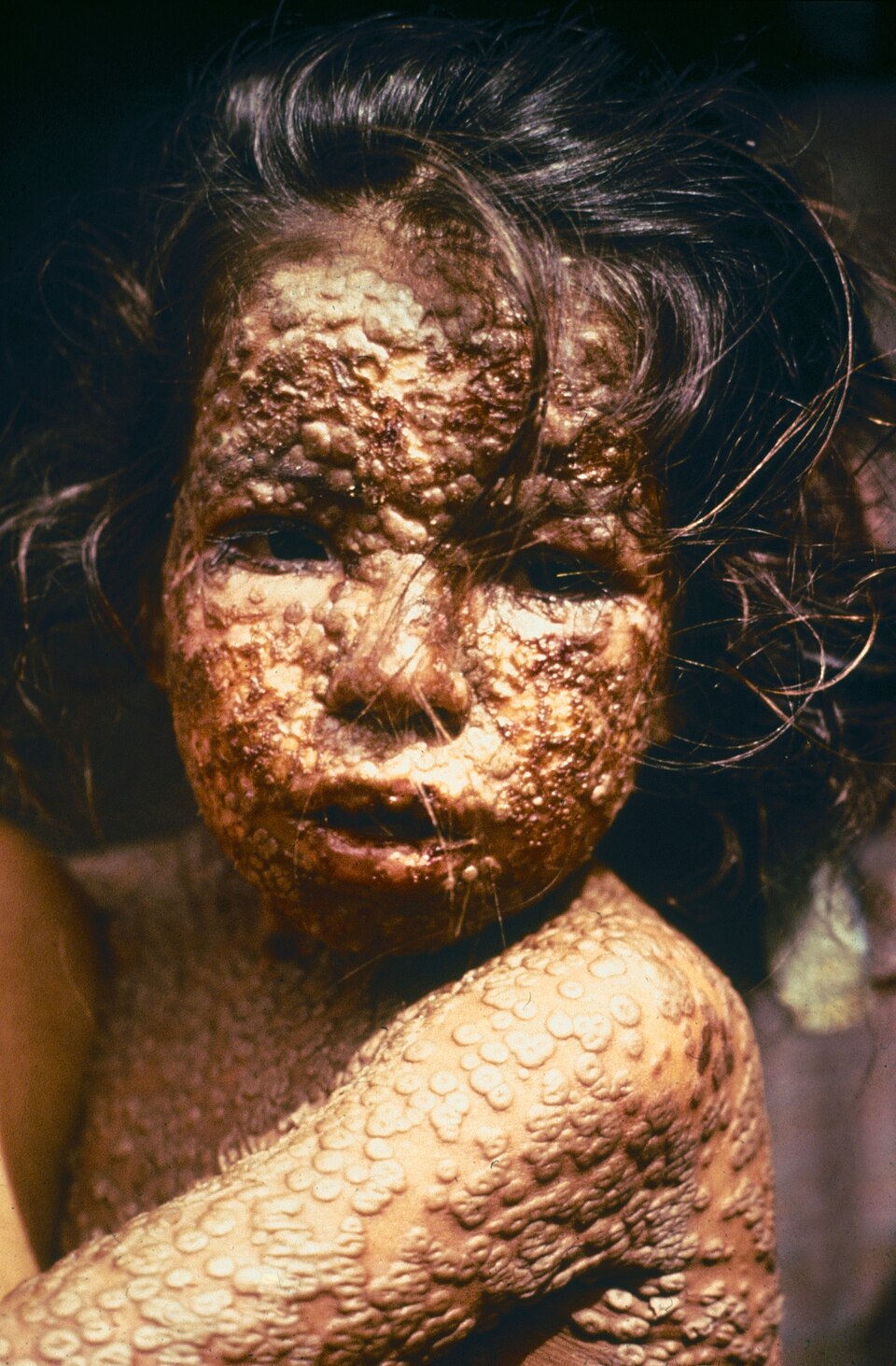
- Vesicles: Over another two days, the papules would evolve into fluid-filled blisters, or vesicles. These vesicles were typically deep-seated, firm to the touch, and critically, all the lesions on a given part of the body would be in the same stage of development—a key diagnostic differentiator from other rash illnesses.
- Pustules: By approximately the sixth day of the eruption, the vesicles would swell and become pustules, filled with thick, opaque pus. These were the most characteristic lesions of smallpox, often described with a "dark swollen rim and a central depression"—the notorious "Pockennabel" or "pockmark navel." This umbilication, or indentation in the center, was a hallmark feature. The formation of pustules often coincided with a resurgence of fever, indicating the body's renewed struggle against the infection and potential secondary bacterial infections.
The Desiccation and Scabbing Phase: The Lingering Aftermath
After approximately two weeks in the pustular stage, the lesions would begin to dry, forming thick, hard crusts or scabs. During this "stadium exsiccationis," the fever would typically subside. However, these scabs remained highly infectious until they completely detached. Once the scabs fell off, they left behind the characteristic, deeply pitted scars, especially prominent on the face, which served as a lifelong reminder of the brutal disease. Even at this late stage, severe cases could still prove fatal.
Variations in Severity: Understanding Different Forms of Smallpox
While the general progression of Variola was consistent, its clinical presentation could vary significantly in severity, leading to different classifications based on the extent and nature of the lesions.
- Variola Vera (Ordinary Smallpox): This was the most common and classic form, accounting for the majority of smallpox cases. It followed the detailed progression of macules to papules to vesicles and finally to the deep, umbilicated pustules, leaving distinct scars. The severity could range from discrete (lesions separate) to confluent (lesions merging, covering large areas of skin), with confluent smallpox being far more dangerous.
- Variola Haemorrhagica (Black Pox): The most dreaded and lethal form of smallpox, Variola haemorrhagica, was thankfully rare but almost universally fatal. It was characterized by widespread hemorrhages beneath the skin and mucous membranes, giving the patient's skin a dark, bruised appearance, hence the name "black pox." This form progressed rapidly, often leading to death within 3 to 5 days due to massive internal bleeding and systemic shock, without the typical pustular eruption.
- Variola Maligna (Flat Pox): Also a severe and often fatal type, Variola maligna was characterized by lesions that remained soft and flat, failing to develop into the firm, raised pustules typical of Variola vera. The skin had a velvety feel, and the rash often coalesced into large, soft plaques.
- Variolois and Variola Mitigata: These were milder, modified forms of smallpox, almost exclusively seen in individuals who had been previously vaccinated but whose immunity had waned. In Variola mitigata (Latin: *mitigatus* meaning "mild or softened"), the disease course was significantly shortened and less severe. Blisters might dry without forming pus, or they might develop into small nodules with only a few vesicles. Sometimes, the lesions would dry into warty elevations (Variolois verrucosa). While still contagious, these forms had a much lower mortality rate and left fewer, if any, scars. The existence of these milder forms provided powerful evidence of the vaccine's protective efficacy.
Diagnostically, in addition to the clinical presentation of sudden onset with chills and severe back pain, laboratory confirmation involved identifying "GUARNERI's bodies"—characteristic eosinophilic inclusions in the cytoplasm of infected cells, often detected through inoculation onto a rabbit cornea in research settings.
A Triumph of Public Health: The Global Eradication of Variola
The story of Variola is unique, not only for the devastation it wrought but for the unprecedented victory humanity achieved over it. The fight against smallpox culminated in one of the greatest triumphs in public health history: its global eradication. The last naturally occurring case of smallpox was diagnosed in October 1977 in Somalia, and just three years later, in 1980, the World Health Organization (WHO) officially certified the global eradication of the disease. This monumental achievement made smallpox the only human disease to have been completely eradicated, a testament to what sustained international cooperation and scientific ingenuity can accomplish.
The success of the smallpox eradication campaign can be attributed to several key factors, providing invaluable lessons for future global health initiatives:
- An Effective Vaccine: The smallpox vaccine, pioneered by Edward Jenner in the late 18th century, was highly effective and provided long-lasting immunity.
- Human-Only Host: Crucially, the Variola virus exclusively infected humans, with no animal reservoir. This meant that once the virus was eliminated from the human population, it had nowhere else to hide and could not re-emerge from other species.
- Visible Symptoms: Infected individuals displayed clear, visible symptoms, making it relatively easy to identify cases and trace contacts. There were no asymptomatic carriers for smallpox, which greatly simplified surveillance efforts.
- Global Strategy: The WHO's intensified eradication program, launched in 1967, employed a two-pronged strategy:
- Mass Vaccination: Widespread vaccination campaigns to build herd immunity.
- Ring Vaccination: A targeted approach where, upon identification of a new case, all contacts and their contacts within a geographical "ring" were immediately vaccinated. This contained outbreaks effectively by creating a protective barrier around infected individuals.
- Political Will and Surveillance: Unwavering political commitment from member states and a robust surveillance system to detect every last case were critical. Teams meticulously tracked outbreaks, often traveling to remote regions, isolating patients, and vaccinating communities.
The eradication of smallpox stands as a beacon of hope, demonstrating that with collective effort, resources, and dedication, even the most formidable diseases can be overcome. It serves as a powerful reminder of the importance of vaccines, global health equity, and strong public health infrastructure.
Conclusion
The journey of Variola, from its devastating reign of fever and characteristic blisters to its historic defeat, is a profound narrative of human suffering, scientific ingenuity, and global collaboration. Understanding the intricate progression of its symptoms—from the initial, severe prodromal phase to the unmistakable umbilicated pustules and the final scarring—illuminates the formidable challenge it posed for millennia. Its eradication, certified in 1980, marks an unparalleled achievement, a testament to the power of a safe and effective vaccine, dedicated public health efforts, and unwavering international cooperation. Though the
Variola virus no longer circulates naturally, its history remains a vital lesson, reminding us of the fragility of human health and the enduring triumph possible when humanity unites against a common enemy. The legacy of smallpox is not one of fear, but of profound hope for the future of global public health.